

Airspace Awareness from Start to Finish - Here's How It Works
Most event security is built around what happens on the ground. The airspace above your site has historically been nobody's job, which is why unauthorized drones have been able to fly over crowds with almost no consequence.
Here's how we change that.
Before the event
We map your site with you.
Every event has zones that matter more than others. The main stage. The VIP area. The production compound. The crowd itself.
We work through those zones with your team before the event, each with its own alert rules. A drone drifting past your parking lot isn't the same as a drone tracking toward the stage, and the system needs to know the difference.
Setup.
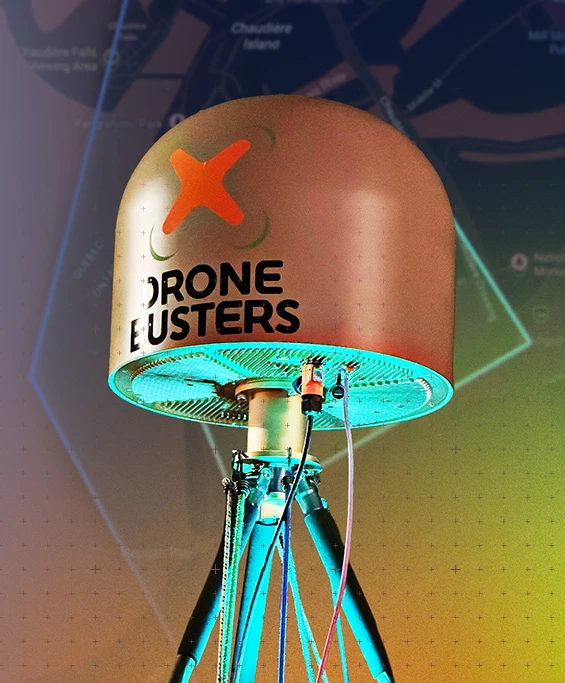
The unit takes 15 to 30 minutes to deploy. A tripod, a power connection, and that's it — no specialist install, no infrastructure. It can run off site power, battery backup, or a solar generator if you're in a field with nothing nearby.
It's built to the standard of airport and police installations, designed for continuous outdoor operation, so ordinary festival weather isn't an issue.
During the event
We detect.
Our system monitors the radio spectrum across your site, out to 10 kilometres in open conditions, and puts every aircraft it identifies on a live map.
In most cases the drone appears on our screen before it leaves the ground. If someone in the parking lot powers up a controller, we know about it while they're still unfolding the props.
The system recognizes 99% of commercially available drones — DJI, Autel, Parrot, and the rest — and identifies make and model, not just "something is flying."
We assess.
Not every drone is a threat, and an alert that fires constantly is an alert your team learns to ignore.
So the system watches behaviour. How fast it's moving. Whether it's hovering. Whether it's climbing rapidly or descending toward people. Whether it's heading for a zone you've told us to protect. Each drone gets a risk level that updates as it flies.
Alerts only fire when an identified drone enters a zone you've defined. Cross into a medium zone and your team gets an early warning. Cross into a red zone and the alert goes out immediately, at full priority.
We locate the pilot.
This is the part that matters.
Detecting a drone tells you that you have a problem. Locating the operator tells you what to do about it. Our system pinpoints where the pilot is standing, accurate to within a metre, and puts that position in your team's hands.
Your security staff or local police go directly to that person. No sweeping the grounds, no waiting for the drone to land and hoping someone spots where it went.
We stay on it.
We monitor the system live for the duration of your event. Alerts reach your team by SMS, email, and dashboard, and we're in contact throughout. The system tracks up to 100 drones at once, so a busy sky isn't a problem.
After the event
Detection records are retained for at least 30 days. If you need documentation for a police report, an insurance claim, or a conversation with a promoter, it's there — flight paths, timestamps, operator positions, aircraft identification.
The post-event picture is useful on its own. Knowing what actually flew over your site, and when, changes how you plan the following year.
What You Need to Provide
Power and a place to put the unit. A seat in your command post and a radio if you have one spare. Beyond that, nothing - no equipment purchase, no software for your team to learn, no technical expertise required.
Fill out the form to the right to get started. We look forward to hearing from you about your event!